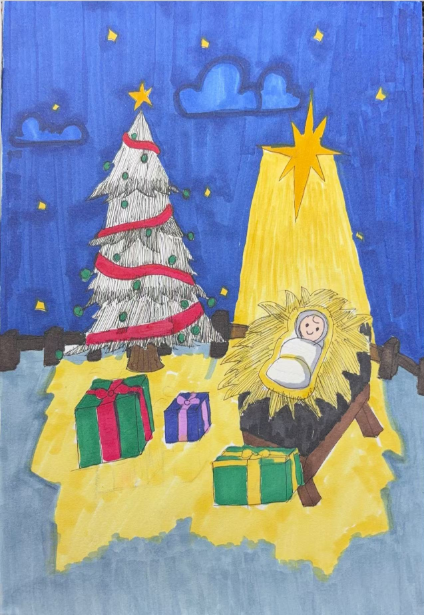
Christmas is approaching once again. The lights, carols, gifts, cards, white Christmas trees, silent nights, family reunions, and the hustle and bustle of the city all remind us of one fact: more than two thousand years ago, a little baby was born in Bethlehem, placed in the utmost humility of a manger.
In this chaotic world of intricate and complicated relationships—between and within nations, ethnicities, religions, political parties, and even families—we long for peace but see wars (e.g., between Israel and Hamas, and between Russia and Ukraine). We long for harmony but see partisan division and a refusal to acknowledge one another. We need to rethink: Who is this baby? Why did He come among us?
I. The World Today: In Need of True Light
The past year has been anything but tranquil. Wars persist; confrontations between nations continue; social tensions remain high; and pressure, anxiety, and loneliness shroud many like a fog. The human heart longs for understanding, longs for someone who truly "gets" us. Yet, our experiences often leave us feeling alienated.
The Bible says, "The true light that gives light to everyone was coming into the world. He was in the world, and though the world was made through him, the world did not recognize him. He came to that which was his own, but his own did not receive him." (John 1:9–11)
The birth of Jesus is light entering darkness; it is God bending down to enter our reality—our pain, our weakness, our limitations, and our confusion. Without Him, we cannot even grasp the meaning of true love, truth, and redemption.
II: The Story of the Little Bird: A Barrier to Communication
A few days ago, I heard the sound of a "thud" against the glass, but I didn't pay it much mind. My son went to check and said a bird had hit the window and appeared stunned. Sure enough, a little bird was indeed crouching in a daze on the ground. I gently cupped it in my hands, brought it inside, gave it some water, and offered it some millet. As the bird regained strength, it struggled to fly away despite my soft whispers: "Don't be afraid, I won't hurt you. If you are willing, you can rest here safely; I will take care of you."
But the bird couldn't understand me. Even though I treated it gently, it remained panic-stricken, fluttering wildly until it hit the glass again. Its struggle made me wish I could speak the language of birds—to let it understand my goodwill and know I was its helper, not its enemy.
As I watched the bird eventually fly away, I suddenly understood something deeply: If someone is not of your kind and does not speak your language, no matter how much kindness you show, they cannot truly understand you.
This insight is precisely the key to the mystery of Christmas.
III: The Story of the Savior: The Word Became Flesh
We often mistakenly believe that for God to save us, He only needed to say from heaven, "I love you all, let it be so," or perform a few miracles to convince people.
But the truth is that humans do not understand God's language. Humans have a natural fear, misunderstanding, and tendency to flee from God. Even if God's heart is full of loving-kindness, we remain as panic-stricken as that little bird.
Therefore, God chose the only way to truly communicate, the only way for us to understand: He became a man; He became one of us.
The Bible says: "The Word became flesh and made his dwelling among us." (John 1:14) And, "Who, being in very nature God... made himself nothing by taking the very nature of a servant, being made in human likeness." (Philippians 2:6–7)
He did not shout from a distance. Instead, He walked into our time and space, enfleshed as a man who could empathize with our needs, pains and weaknesses. He was hungry and thirsty, He wept, He was tempted, He shed tears, He was misunderstood. He spoke human language to tell us of God's love. He took on human form to reveal to us the path of redemption.
Just as the bird could only understand my care if I became a bird, so too could humanity only understand God’s love if He became human.
IV: Our Hope: Understanding God’s Heart
The Incarnation (The Word becoming flesh) is not merely a religious concept; it is a fact of life. It tells us:
- God is not aloof and indifferent. He entered our world of suffering to shoulder the yoke with us.
- God is willing to speak to us in our own language. Jesus told parables and stories, and spoke of the Father's love, all so that people could understand.
- God is willing to personally bear our sins. He does not save us with theory but with the Cross.
- God is willing to accompany us through every step of life. Christmas is not a once-a-year ritual, but an emblem of God's eternal companionship.
V. Pastor’s Reflections: Do You Feel the Love?
Just as I had held that stunned little bird in the palm of my hand, Christmas reminds us of God’s love for us, and that He uses his hands to sustain our lives! He does not command us to "fly better." He walks into our world to guide us home.
This Christmas, may you once more hear and understand the words the Incarnate Lord is speaking to you:
"Do not be afraid. I bring you good news that will cause great joy for all the people. Today in the town of David a Savior has been born to you; he is the Messiah, the Lord." (Luke 2:10–11)
"I have come that they may have life, and have it to the full." (John 10:10)
May the Incarnate Lord be your true peace and hope in this turbulent era.

-
Chinese Christian Church of Greater Washington DC